
Last night, Sarah came home to find her living room transformed into a war zone. Her 3-year-old Golden Retriever, Max, was experiencing severe dog separation anxiety, resulting in intense separation-related behaviors. He had torn through couch cushions, scratched deep grooves into the hardwood door, and shown extreme destructive behavior in dogs, a common sign of separation anxiety in dogs. The worst part? The blood on his paws from repeated escape attempts—clear dog anxiety symptoms and even early dog panic attacks linked to canine separation anxiety and canine anxiety disorders.

If this scenario sounds familiar, you’re not alone. Studies show that nearly half of U.S. dogs display moderate to severe anxiety, with over 85% showing some form of dog separation distress or related pet behavioral problems. These dog behavioral issues often include chewing, scratching, vocalization, and elimination accidents—hallmark signs of untreated separation anxiety treatment needs. For many owners, the growing separation anxiety cost comes not only from home damage, but from repeated vet visits, failed dog training methods, and ineffective dog crate training attempts.
What’s most shocking is that despite how common this form of pet anxiety treatment has become, many dog parents unknowingly worsen the condition. Well-meaning but misguided approaches—such as punishment, isolation, or inconsistent routines—can intensify animal behavior modification challenges instead of resolving them. The truth is, dog separation anxiety is not a simple obedience problem. It’s a complex emotional crisis that often requires systematic desensitization, guidance from a qualified veterinary behaviorist, and in some cases, anxiety medication for dogs as part of a long-term dog anxiety prevention and recovery plan.
Separation Anxiety vs. Other Behavioral Issues
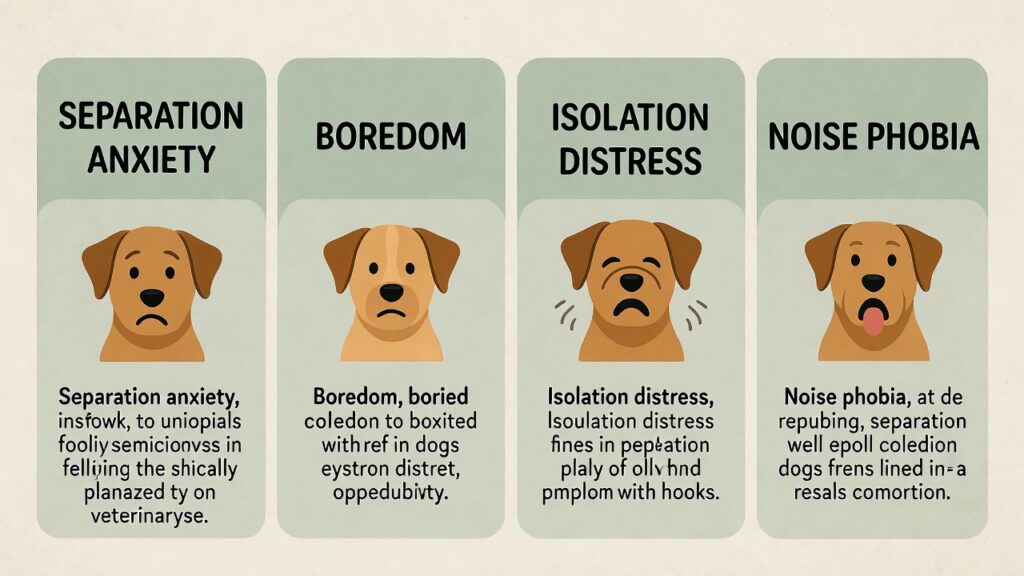
Many dog parents misidentify their dog’s behavioral issues, leading to ineffective treatment approaches. Understanding the key differences between separation anxiety and other common behavioral problems is crucial for proper diagnosis and treatment.
| Condition | Primary Trigger | Key Behaviors | When It Occurs | Distinguishing Features |
|---|---|---|---|---|
| True Separation Anxiety | Departure of specific person | Distress behaviors within minutes of departure, extreme excitement upon return | Only when guardian is absent | Dog remains anxious even with other people/pets present; focused on one specific person |
| Isolation Distress | Being completely alone | Destructive behaviors, excessive vocalization, pacing | Whenever completely alone | Fine with other people/dogs present; resolved by any companionship |
| Boredom/Under-stimulation | Lack of mental/physical exercise | Chewing household objects, digging | Random times when alone | Behaviors increase over separation period rather than peaking early |
| Medical Issues | Urinary tract, gastrointestinal, or cognitive dysfunction | Elimination accidents, confusion | Various times | Recent onset, may occur when owner present |
| Noise/Storm Phobia | Specific environmental triggers (thunder, loud noises) | Similar to separation anxiety | During storms or specific noise events | Triggered by identifiable environmental stimuli |
Key Diagnostic Questions:
- Does your dog remain anxious when left with other people? If yes, it’s likely separation anxiety rather than isolation distress
- Do behaviors only occur in your absence? This supports separation-related diagnoses
- Having video monitoring available makes figuring out your dog’s threshold for alone time much easier.
The Hidden Truth About Separation Anxiety That Veterinary Behaviorists Don’t Want You to Miss
Separation anxiety in dogs should be viewed as a symptom of deeper emotional frustration rather than a single diagnosis. Understanding these root causes is essential for effective separation anxiety treatment and long-term pet anxiety treatment. Recent research shows that dog separation anxiety is more complex than previously thought and often overlaps with canine anxiety disorders and other pet behavioral problems.
Scientists from the University of Lincoln identified four drivers of separation-related behaviors: escaping something inside the home, reaching something outside, reacting to external noises, and boredom. These triggers commonly lead to dog anxiety symptoms, dog panic attacks, and destructive behavior in dogs.
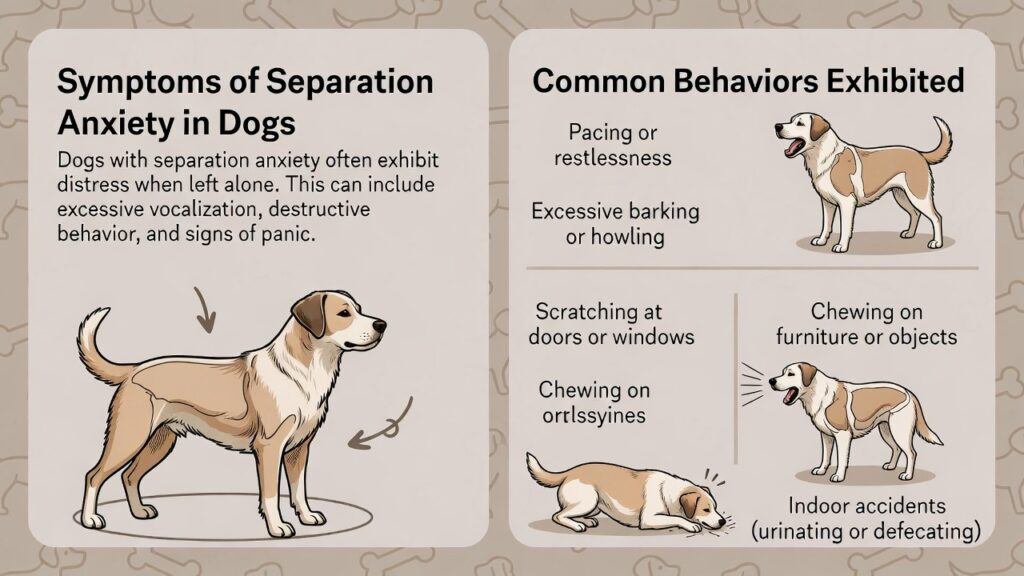
This explains why traditional dog training methods and dog crate training often fail. Without systematic desensitization, proper animal behavior modification, and guidance from a veterinary behaviorist, dog separation distress may worsen, increasing the overall separation anxiety cost and the need for anxiety medication for dogs.
Important: Anxiety isn’t always behavioral. Certain diets can quietly worsen stress, heart health, and emotional regulation in dogs. If your dog is on a grain-free diet, you should read this immediately: Grain Free Dog Food May Be Hurting Your Dog’s Heart — Here’s What to Do Now
The Post-Pandemic Reality: A Perfect Storm
Between the start of the COVID-19 pandemic in early 2020 and January 2022, over 23 million American households welcomed new canine companions into their families. This means that as owners have been called back into the office in more recent years, many pairings have had to separate for the first time.
Yet, the return to pre-pandemic routines has introduced new challenges —particularly for our pets — with cases of canine anxiety jumping by more than 700% since the pandemic’s peak.
Latest Research Updates (2025-2026)
Groundbreaking Discoveries in Canine Anxiety

Multi-Faceted Anxiety Types: Interest has been growing in the multi-faceted etiology and the possible identification of different sub-types of separation-related behavior problems in companion dogs. Our core hypothesis was that the variability of the diverse signs—at least partially—can be explained by the different underlying affective states.
Prevalence Statistics: The prevalence estimate for noise sensitivity was 39.2 %, 26.2% for general fearfulness, and 17.2% for separation anxiety. However, newer studies show much higher rates, with up to 50–56% of the pet dog population may display clinical signs of SRBs at some stage in their lifetime , it is estimated that up to 70 million dogs across the United States and Europe could present with SRBs during their lifetimes.
Breed-Specific Findings: Furthermore, dog breeds showed large differences in prevalence of all anxiety-related traits, suggesting a strong genetic contribution. As a result, selective breeding focusing on behaviour may reduce the prevalence of canine anxieties.
Behavioral Manifestation Research
Vocalization Patterns: Research shows that dogs with separation problems exhibit distinct vocal behaviors, with anxiety-related whining occurring sooner than barking behaviors during separation periods.
The Devastating Statistics Pet Parents Need to Know
| Statistic | Percentage | Source |
|---|---|---|
| Dogs with moderate to severe separation issues | 85.9% | Modern Sciences Study 2025 |
| Dogs experiencing some separation-related behaviors | 50-56% | PMC Studies 2025 |
| Post-pandemic anxiety increase | 700%+ | Pawlicy Research 2024 |
Peer-reviewed studies published in PubMed Central estimate that up to 56% of dogs display separation-related behaviors.
Daniel Mills, Professor of Veterinary Behavioural Medicine in the School of Life Sciences at the University of Lincoln, said: “Until now, there has been a tendency to think of this as a single condition, ie “My dog has got separation anxiety” and then to focus on the dependence on the owner and how to make them more independent. However, this new work indicates that having separation anxiety is more like saying “My dog’s got an upset tummy” which could have many causes and take many forms, and so both assessment and treatment need to be much more focussed.
Why 85% of Dog Parents Are Making These Critical Mistakes
Mistake #1:
Treating It as a Training Problem Instead of an Emotional Crisis
The biggest misconception is thinking separation anxiety can be “trained out” like jumping or pulling on a leash. The reality? Separation anxiety is a panic response, similar to human panic attacks. You wouldn’t tell someone having a panic attack to “just calm down” and expect it to work.
Dogs displaying SRBs are often in a compromised emotional state, with anxiety (an emotional reaction to a potential or predicted danger or uncertainty ) being one of the commonly associated states for dogs displaying SRBs. However, research has also suggested frustration, panic, fear, and boredom, as other negative affective states associated with different types of SRBs.
Mistake #2:
Using Crates as a “Quick Fix”
Many dog parents assume crating will solve the problem by containing destructive behavior. However, research shows this approach often backfires spectacularly. Dogs will still engage in anxiety responses inside a crate and may urinate, defecate, howl, or even injure themselves attempting to escape.
Mistake #3:
Inconsistent Management During Training
Prior to starting systematic desensitization with your dog to treat their separation anxiety, you must commit to never leaving them alone for longer than they can handle. Every time they experience anxiety when left alone, the behavior pattern and negative emotional response are strengthened, increasing their anxiety over time.
Cost Breakdown of Treatment Options: What to Budget in 2025-2026
Professional Consultation Costs
| Professional Type | Session Cost | Typical Duration | Total Investment |
|---|---|---|---|
| Board-Certified Veterinary Behaviorist | 200-\400 | 6-12 months | 2,500-\5,000+ |
| Certified Applied Animal Behaviorist (CAAB) | 150-\300 | 4-8 months | 1,500-\3,500 |
| Certified Professional Dog Trainer (CPDT) | 70-\125 per hour | 3-6 months | 800-\2,000 |
| Certified Separation Anxiety Trainer (CSAT) | 175-\250 | 4-6 months | 1,800-\3,200 |
Medication Costs (Monthly)
Anxiety medication for dogs costs $20 and $100 for a monthly supply. The price you pay varies based on the brand, frequency, and dosage your pet is prescribed.
| Medication | Brand Name | Generic Cost | Branded Cost | Duration |
|---|---|---|---|---|
| Fluoxetine | Reconcile | 15-\35 | 60-\120 | 4-6 weeks to see effect |
| Clomipramine | Clomicalm | 25-\50 | 80-\150 | 4-6 weeks for therapeutic effect, up to 2 months for full evaluation |
| Trazodone | Generic available | 10-\25 | 35-\60 | As needed basis |
| Alprazolam | Generic available | 8-\20 | 25-\45 | Short-term use only |
Total Treatment Investment Ranges
- Mild Cases: 800-\2,500 (3-4 months)
- Moderate Cases: 2,000-\5,000 (6-8 months)
- Severe Cases: 3,500-\8,000+ (8-12+ months)
Regional Variation in Treatment Approaches
United States
- As a result, in the USA, there are two Food and Drug Administration–approved medications to treat this problem.
- Currently Clomicalm, Reconcile, and Sileo are the only FDA-approved medications for use in dogs. The other available medications that your vet may recommend for your dog’s anxiety are all human medications, used off-label in dogs.
European Union
- This realization eventually resulted in the change of the previously used term ‘separation-anxiety’, to more general terms such as ‘separation related disorder’ or ‘separation related problem’. For example, Sherman and Mills19 state that “The term separation distress may best describe the phenomenon, which incorporates signs consistent with anxiety, fear, and phobic behavior”.
The Science-Backed Solution
The most successful treatment for canine separation-related problems may be behavior modification that focuses on systematic desensitization and counterconditioning, which can be supplemented with medication. In the past four decades, separation anxiety has been the most commonly discussed disorder in published studies of experimental research and retrospective research in the fields of applied animal behavior and veterinary behavior.
The “One Second at a Time” Method
Phase 1: Pre-Departure Cue Desensitization (Week 1-2)
As mentioned above, some dogs begin to feel anxious while their guardians get ready to leave. For example, a dog might start to pace, pant and whine when he notices his guardian applying makeup, putting on shoes and a coat, and then picking up a bag or car keys.
Start by identifying your dog’s “trigger cues”—the signals that tell them you’re leaving:
- Picking up keys or phone
- Putting on shoes or coat
- Grabbing purse, briefcase, or lunch
- Turning off TV or music
Practice these cues repeatedly throughout the day without actually leaving. Pick up your keys, wait 5 seconds, then put them down. Repeat 10-15 times daily until your dog shows no reaction.
Phase 2: Micro-Departures (Week 2-4)
Initially, the dog is exposed to very short periods of owner absence (it is assumed that this will not elicit anxiety). Begin with literally stepping outside for 2-3 seconds.
Critical Rule: It’s essential to avoid triggering a full anxiety response, so if your dog begins to show signs of distress, it may be necessary to reduce the duration and progress even more slowly.
Phase 3: Duration Building (Week 4-12)
This means that over weeks of conditioning, you’ll increase the duration of your departures by only a few seconds each session, or every couple of sessions, depending on your dog’s tolerance at each level. Once your dog can tolerate 40 minutes of separation from you, you can increase absences by larger chunks of time (5-minute increments at first, then later 15-minute increments).
Once your dog can be alone for 90 minutes without getting upset or anxious, he can probably handle four to eight hours.
Essential Management Strategies During Training
| Strategy | Success Rate | Implementation |
|---|---|---|
| Complete Management Plan | 95% when followed | To combat this, we suspend all absences — not leaving your dog alone at all. |
| High-Value Enrichment | 60% mild cases | Keep in mind, though, that this approach will only work for mild cases of separation anxiety because highly anxious dogs usually won’t eat when their guardians aren’t home. |
| Calm Departures/Arrivals | 80% compliance | Neutral hellos/goodbyes |
1. Complete Management Plan
Absolute Requirements:
- Arrange doggy daycare or pet sitting
- Take dog to work if possible
- Use family/friend support during training period
- Never leave dog alone except during training sessions
2. High-Value Enrichment
For example, try giving your dog a KONG® stuffed with something really tasty, like low-fat cream cheese, spray cheese or low-fat peanut butter, frozen banana and cottage cheese, or canned dog food and kibble. A KONG can even be frozen so that getting all the food out takes even more of your dog’s time. Be sure to remove these special toys as soon as you return home so that your dog only has access to them and the high-value foods inside when he’s by himself.
3. Calm Departures and Arrivals
Emotional hellos and goodbyes increase your dog’s excitement and anxiety. Keep departures neutral: a calm pat, “see you later,” and go. Upon return, greet briefly and calmly, then ignore until they settle.
The ASPCA emphasizes management strategies such as avoiding emotional goodbyes and providing enrichment during absences.
When Medication Becomes Necessary: The Game-Changer
For moderate to severe cases, anti-anxiety medication can reduce the intensity of anxiety your dog is feeling and increase the speed and effectiveness of behavior modification treatment. It is beneficial to consider anxiety medication early in the treatment of your dog’s separation anxiety.
FDA-Approved Options:
- Reconcile (fluoxetine) is a selective serotonin-reuptake inhibitor (SSRI) that raises levels of the neurotransmitter serotonin—a hormone that promotes your dog’s feelings of well-being and calmness—in the brain.
- Clomicalm, which is an FDA-approved treatment for separation anxiety in dogs. It’s a tricyclic antidepressant medication that works by increasing the levels of the nervous system chemical messengers, serotonin and norepinephrine, which affect mood.
Timeline for Success: What to Realistically Expect
This process can take anywhere from a few weeks to months.
| Phase | Timeline | Expected Progress |
|---|---|---|
| Initial Improvement | 4-8 weeks | Reduced pre-departure anxiety |
| Significant Progress | 3-6 months | 40+ minute departures possible |
| Complete Resolution | 6-12+ months | 4-8 hour absences manageable |
Critical Success Factors:
- Never allow panic during training sessions
- Maintain complete management between training
- Provide adequate physical and mental exercise
- Seek professional help for moderate to severe cases
Who Can Help: Finding the Right Professional
Because treatment must progress and change according to the pet’s reactions, and because these reactions can be difficult to read and interpret, desensitization and counterconditioning require the guidance of a trained and experienced professional. For help designing and carrying out a desensitization and counterconditioning plan, consult a Certified Applied Animal Behaviorist (CAAB or ACAAB) or a board-certified veterinary behaviorist.
Look for:
- Certified Applied Animal Behaviorist (CAAB or ACAAB)
- Board-certified veterinary behaviorist (Dip ACVB)
- Certified Professional Dog Trainer (CPDT), but be sure that the trainer is qualified to help you. Determine whether she or he has education and experience in treating fear with desensitization and counterconditioning, since this kind of expertise isn’t required for CPDT certification.
The Critical Success Factors Most Dog Parents Miss
The 5-Instruction Rule
Where individual therapy from an animal behavior expert is not possible, advice to dog owners should be clear, simple, and contain five or fewer instructions to improve adherence. Focus on consistency over complexity:
- Never allow panic during training
- Start with literally seconds, not minutes
- Maintain complete management between sessions
- Keep departures and arrivals calm
- Exercise your dog before departures
Environmental Modifications That Work
Safe Space Creation:
- Choose a quiet room with windows
- Add comfort items with your scent
- Provide mental enrichment activities
- Consider calming music, or pheromone products like Adaptil that mimic the comforting scents of a mother dog.
Advanced Strategies for Severe Cases
Video Monitoring Protocol
Use cameras to document your dog’s behavior during absences. Because the separation-related problem behaviors begin shortly after the departure of the owner – a latency of 3.25 minutes for vocalization and 7.13 minutes for destruction11 – the initial separation period must be short to ensure that the owner’s absence is not associated with problem behaviors and, presumably, anxiety.
This helps identify:
- Peak anxiety periods (usually first 40 minutes)
- Specific triggers causing distress
- Progress indicators during treatment
- Signs of stress not visible through destruction alone
Prevention: Building Confidence From Day One
For New Puppies:
- Protective factors include ensuring a wide range of experiences outside the home and with other people, between the ages of 5-10 months, stable household routines and absences from the dog, and the avoidance of punishment.
- Practice regular short absences from early age
- Create positive associations with alone time
For Adult Dogs:
- Gradually increase alone time before major schedule changes
- Maintain consistent routines when possible
- Provide adequate physical and mental stimulation
- Address anxiety early before it becomes severe
The American Kennel Club recommends early, positive exposure to alone time to reduce future anxiety.

Many dog parents miss early warning signs because they don’t know what questions to ask their vet. If you want to prevent anxiety from becoming severe, this guide is essential reading: Pet Health Questions: 15 Essential Answers Every Pet Owner Needs
The Bottom Line
You can “cure” anxiety in dogs in some cases, such as separation anxiety in dogs who are being left alone or introduced to strangers for the first time. You may be able to cure this type of dog anxiety with patience, training, desensitization, and environmental changes, like providing them with plenty of mental stimulation and a safe space.
The key is understanding that this isn’t about training compliance—it’s about emotional healing. Your dog isn’t being “bad” or “stubborn.” They’re experiencing genuine distress that requires patience, consistency, and often professional guidance.
Curing dog separation anxiety quickly is not always feasible. The resolution often requires patience, consistency and a systematic approach. The journey may be measured in seconds at first, but each small step builds toward genuine freedom for both dog and owner.
Remember, seeking professional help isn’t admitting failure—it’s giving your beloved companion the best possible chance at overcoming their fear and living a happy, confident life. The investment in proper treatment pays dividends in years of stress-free departures and peaceful homecomings ahead.
If your dog is struggling with separation anxiety, you don’t have to figure this out alone. At PetCastel, we publish science-backed, vet-informed guides to help pet parents make confident decisions—before anxiety turns into lifelong distress.
Explore more trusted dog health and behavior resources at: Petcastel
Common Questions From Concerned Dog Parents
Q: How long will this take?
A: The timeline for improvement can vary significantly based on the dog’s temperament, history and the severity of the anxiety. While some dogs may show rapid improvement with consistent training and positive reinforcement, others might require a longer period and a combination of interventions.
Q: Can I use a crate during training?
A: Only if your dog is already crate-trained and shows no signs of confinement anxiety. Never force crating on an anxious dog—it often worsens the condition.
Q: Will getting another dog help?
A: Research shows the presence of another dog doesn’t prevent separation anxiety and can sometimes complicate treatment. Focus on helping your current dog first.